
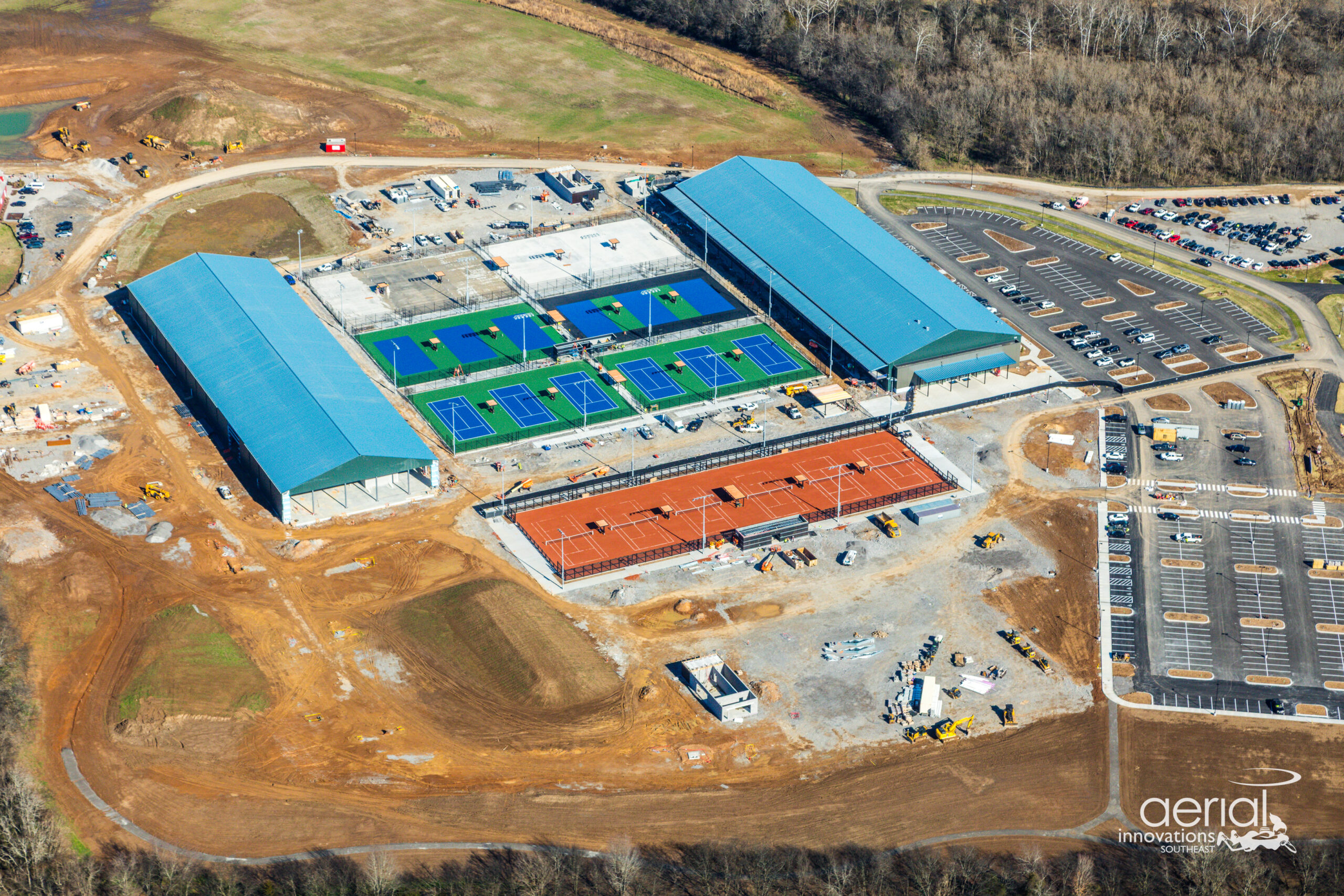
On a plot of land in rural College Grove, Tennessee, what began as a small sports complex has evolved over the last several years into an expansive development, servicing tennis and performance athletes — from amateur to professional — just a half-hour outside of Nashville.
The Farm & Forge Club, named for its focus on growth and development, sits on 117 acres. JE Dunn was initially engaged through a prior relationship with the owner, who wanted to build a sports facility for his children. However, as the vision grew, the scope of the project expanded quickly.
“It was always pitched to us as just a little sports complex out in College Grove,” said Ryan Van Nest, Senior Project Manager. “It’s turned out to be a lot more in depth than that.”
At the onset of the project, unexpected site conditions added early layers of difficulty. In one case, unsuitable soil in some areas and a lack of soil in others required significant remediation.
“We had to import approximately 109,730 tons of stone to meet the proposed elevation grades on the construction drawings,” Van Nest said.
The first phase of the project included a 63,700-square-foot indoor tennis facility with six indoor tennis courts and 24 exterior tennis courts, six of which are surfaced with clay imported directly from Italy. Also included with the exterior tennis courts are two additional amenity buildings and two maintenance buildings to support these exterior tennis courts.
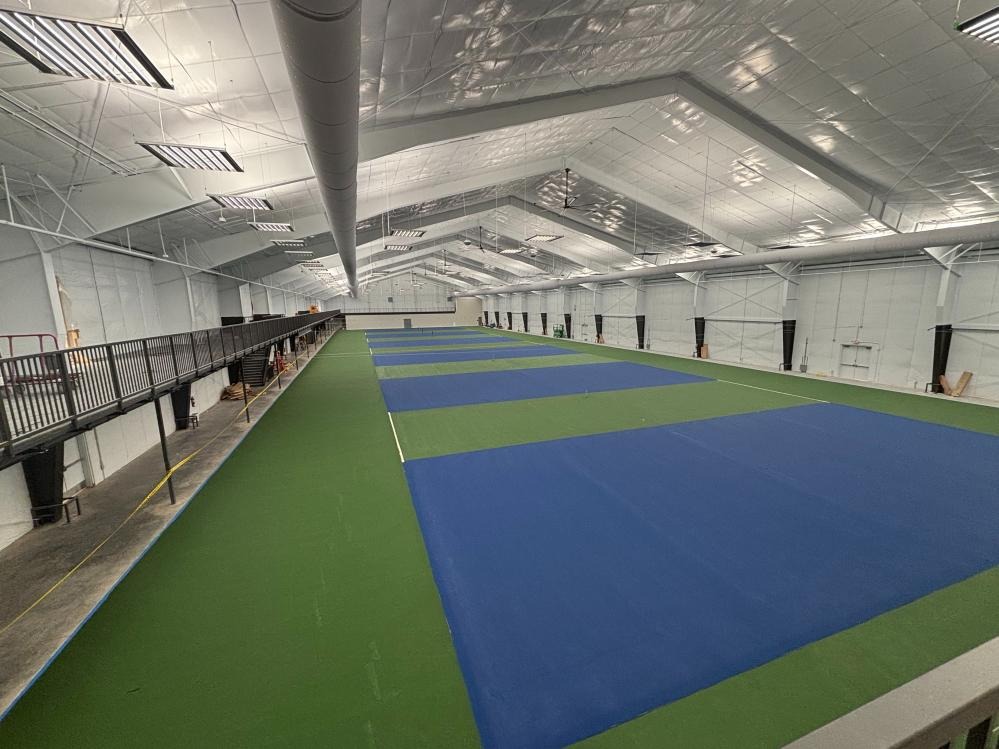
The courts are equipped with an automated computer scoring system that tracks the speed of the tennis ball along with the accuracy of the shot, and whether the ball is in or out of play. The Farm & Forge Club will be the twelfth location in the U.S. to feature the technology.
As the project has progressed, additional buildings, including a second indoor tennis facility and a sports performance and training building, have been added to the project scope of work. Unlike a traditional project with a fixed scope, Van Nest said the team has remained in a near-constant state of pricing and coordination with the owner and their end users.
“We never really got out of pricing or preconstruction because of how the owner has delivered and developed this project,” he said. “It started out as a $2.28 million project, and by the time we execute the Sports Buildings B and Sports Training X GMP packages, the project’s construction costs will be near $110 million.”
In order to continue to deliver quality work, meeting the project’s unique needs has become a central focus for the construction team, particularly on the sports performance and training facility, which is currently under construction and set to open this summer.
“The schedule demand of the client is really where the challenge comes in,” said Matt HermsenWhite, Senior Project Engineer.
To meet these demands, the team made early decisions that helped to reduce uncertainty later on in the schedule. They ordered prefabricated metal buildings months in advance and stored them off-site.
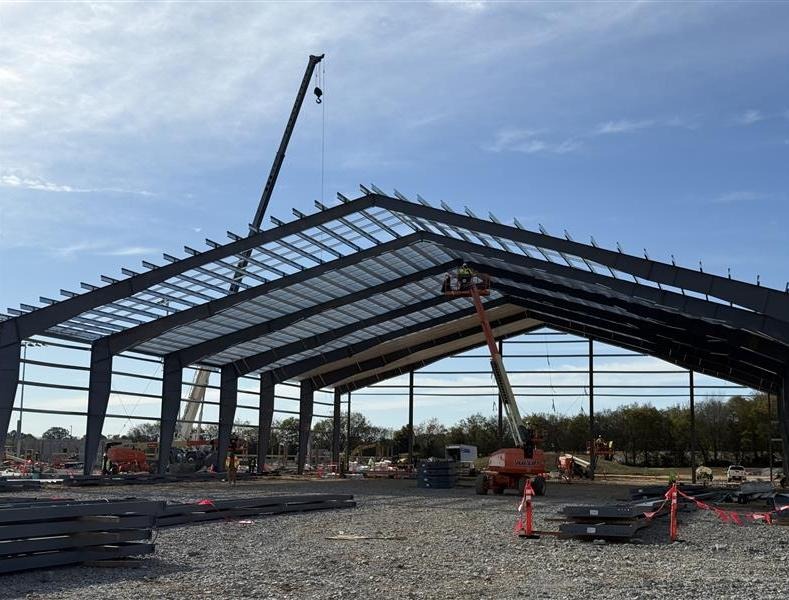
“We had these buildings sitting at an off-site location waiting to be erected while we were waiting for building permits,” Van Nest said.
The team also leveraged JE Dunn’s self-perform capabilities in concrete to compress timelines. HermsenWhite said JE Dunn began foundation work while pricing was still underway, eliminating weeks that would typically be spent on bidding and contracting.
“We just went ahead and proceeded on good faith with the client,” he said. “It probably saved the owner a month, if not six weeks.”
Over the project’s life cycle, the on-site team has grown to support the increasing workload and coordination demands. What began as a small group of two in late 2024 has expanded to more than a dozen team members working out of the project trailers.
“We needed more people to support this project,” Van Nest said. “We probably needed them sooner, but we worked with what we had.”
And despite the project’s extreme pace, the team emphasized their focus on workforce sustainability. They have managed late nights and weekend work through rotations that evenly distribute the workload across the staff.
“The project has long hours, but we’re spreading out the stress and the personal demand so that no one’s getting overwhelmed,” HermsenWhite said.
Van Nest said the project’s phased delivery and quick turnaround created an opportunity for the team to gain experience across every stage of construction in a compressed timeframe.
“You see a full construction process in 12 to 14 months,” he said. “From site work to foundation, to shell, to interiors, to closeout.”
Once complete, the Farm & Forge Club will bring the Nashville area a state-of-the-art facility for tennis and performance training, athletic recovery, and an academic program that focuses its education on the unique demands of student athletes.
Van Nest said the project’s scale and location could influence future development in the surrounding area. For the JE Dunn team, the defining characteristic of the project has been adaptability.
“Everything builds off each other,” Van Nest said. “But we came together as a team to figure out ways to get there and make it successful.”